
Digital PFM in Action: Building Resilient and Inclusive Fiscal Systems for African Governments
Across the African continent, conversations on Public Financial Management (PFM) are changing. Governments are discussing and, at an increasing rate, implementing a redesign of the systems, processes, and procedures they use to collect, manage, spend, and account for public resources.
Digital PFM is increasingly viewed as a strategy for modernising PFM, rebuilding the social contract and making governments more transparent to the public and more responsive to their needs.
Traditionally, PFM reforms have been celebrated for internal milestones such as balanced accounts, new budget lines, earmarking, budget tagging, or updated financial systems. Yet, for many citizens, these achievements do not immediately translate into better services.
NGF participated in CABRI’s Regional Peer Learning and Exchange Workshop on Digital PFM in Action, 9–10 March 2026, in Kigali, Rwanda, where we shared lessons on the evolution of digital PFM reforms with finance ministries from the continent.
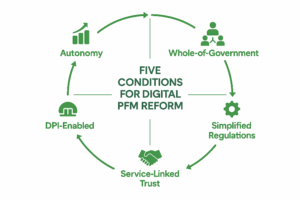
Drawing from our experience supporting Nigeria’s 36 States on PFM reforms, we outlined five conditions that promote an inclusive and resilient operating environment for digital PFM reforms.
1. Autonomy: The Engine of Innovation
Administrative and financial autonomy for fiscal authorities serves as the main driver of Agility. This independence empowers authorities to bypass the bureaucratic bottlenecks that typically stall technology procurement and talent development. In many cases, autonomous authorities can invest a portion of their retained earnings in servers, cloud infrastructure, and competitive salary structures to attract and retain a skilled in-house team capable of maintaining and expanding Agile PFM systems.
In 2019, an NGF study, which reviewed data for 20 Nigerian States and compared their institutional arrangements and sources of funding for the period 2015 – 2018, revealed that autonomy was the single most important factor that facilitated the implementation of other major tax reforms. The report highlighted Kwara, Zamfara, and Bauchi States as three high performers that recorded over 100% growth in their internally generated revenue (IGR) following the implementation of full autonomy for their revenue authorities. Since then, records have shown similar performances for other States.
The evidence, however, also shows that “uncoordinated autonomy” across several agencies within the same government inadvertently accelerates fragmentation. The result is a patchwork of “digital kingdoms” that cannot share information. To manage this risk, autonomy must be exercised within a whole-of-government framework to ensure that each agency’s digital transformation journey does not compromise collective interoperability.
Nevertheless, autonomy provides protection against various forms of government bureaucratic interference over the long term.
2. A Whole-of-Government Approach
PFM fails when viewed as a “Ministry of Finance” project. It is rather a “State” project because of its interconnection with other government institutions and service providers. Line ministries do more than manage data and provide services; they build the public legitimacy and social contract necessary for any reform to take root. This public legitimacy is a critical enabler for successful government reforms when combined with strong policy design and action.
More importantly, government ministries, departments, and agencies fall in line when the head of government is the face of reform and strong political will is demonstrated.
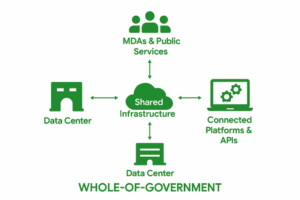
A whole-of-government approach to digital transformation ensures that, instead of 20 different agencies purchasing 20 separate servers, an information highway or shared data centre is adopted to reduce digitalisation costs and enhance data security.
3. Simplify the “Rules of the Game”
Technology is not a quick fix for a highly fragmented regulatory environment. To fast-track automation, laws, regulations and standards must be simplified and made “machine-readable” via identical rules that a computer can process without human intervention. For example, the National Chart of Accounts (NCOA) provides a “common code” for budgeting across all tiers of government in Nigeria, ensuring that a Naira spent in one State is coded and recognised the same way in another State. The Consolidated Revenue Codes (CRC) adopted by the 36 States have also collapsed hundreds of fragmented laws into a single, unified rulebook for revenue administration in each State.
Simplification, harmonisation and consolidation of rules lead to “single window” platforms that harmonise business rules and consolidate citizen services.
4. Service-Based Digitalisation
In many African contexts, the social contract is fragile, but digital PFM offers a convincing mechanism to rebuild that trust. Citizens are far more likely to embrace digital systems when they see a link between their data or payments and the delivery of public services. This trust is fostered through tools such as Open Budgeting, which promotes transparent tracking of expenditures down to the ward level; the Open Contracting Data Standard (OCDS) for monitoring how government contracts are awarded and fulfilled; Tax Administration Management Information Systems (TAMIS), which trigger the immediate issuance of documents, such as Tax Clearance Certificates or health vouchers; and digital registries which act as the “Single Source of Truth” that automates the delivery of rights and benefits.
Automation also acts as a deterrent to corruption by eliminating the discretionary ‘gatekeepers’ that facilitate bribery in public institutions. It portrays government institutions as reliable, professional, and accountable, reinforcing confidence in state systems.
5. Digital Public Infrastructure (DPI)-enabled PFM Reforms
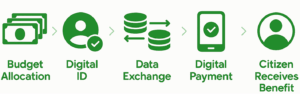
DPI is driving an evolution in PFM. It treats digital identity, payments, and data exchange as the “public roads” on which reforms are laid. On these “rails,” governments build transparent, citizen-connected PFM systems.
DPI-enabled PFM reforms strengthen the PFM value chain, from regulations and processes to service delivery via the DPI pillars, so that PFM reforms are better understood as an end-to-end service system rather than primarily a technical construct. It transforms PFM from a ‘back-office’ task into a service delivery system. For example, digital ID and payments can link budget lines directly to citizen services, such as cash-backed transfers for capital projects, instant service vouchers, certificates, and tax credits, thus making the PFM chain transparent and valued by the public.
Because DPI-enabled PFM links “invisible” digital rails to “tangible” services valued by voters, it has become an effective tool for securing support from political leaders who view digital PFM reforms as intangible.
Consider a Scenario for a Government Fertiliser Subsidy Programme
The Traditional Perspective
The government announces a ₦5 billion “Agriculture Intervention Fund.” On the back end, the Ministry of Finance updates its accounting software to create a budget line for “Subsidy Payments.” While the books are balanced, the farmer in a rural ward has no idea the money exists or how to get it. The “technical” success (the budget is funded) has no “service” connection.
A DPI-Enabled Service
Because the PFM system is built on DPI, it is practised as an end-to-end service:
- Identity Pillar: The farmer is already registered on a digital ID system.
- Data Exchange Pillar: The Ministry of Agriculture’s list of verified farmers “talks” to the Ministry of Finance’s payment system.
- Payment Pillar: Instead of the government saying, “We have the money,” they send a digital voucher directly to the farmer’s phone.
Instead of the government saying, “We have successfully disbursed ₦5 billion in the Agriculture Budget” (Technical), a DPI-enabled reform allows the government to say, “We have sent a fertiliser voucher directly to 50,000 farmers’ phones, which they can redeem instantly at any local depot” (End-to-End Service).
Looking Ahead
The future of digital PFM is also being defined by how well governments safeguard their digital sovereignty and how quickly they adapt to the intelligence revolution.
Contractual Sovereignty: Governments must build their capacity for digital procurement. This will ensure they can negotiate and enter into agreements that better address current and future needs and prevent issues such as acquiring redundant licences, poor proprietary clauses, vendor lock-in, and data loss during contract or technology transitions.
The AI Frontier: Artificial Intelligence will transform PFM in areas such as predictive analytics, smart forecasting, audits, automated expenditure controls, and “Living Budgets.” To benefit early from the AI revolution, governments must secure a seat at the table where AI standards are established.
The governments most ready for the future will include those with pluggable, modular systems that support API-driven frameworks and data interoperability.
Download: Digital PFM in Action: Building Resilient and Inclusive Fiscal Systems for African Governments
About the Author:
David Nabena oversees NGF’s public finance programme with objectives to improve public finance outcomes across Nigeria’s 36 State governments through interventions in research and evidence generation, high-level advocacy, policy support, and capacity building.